 Skip to content

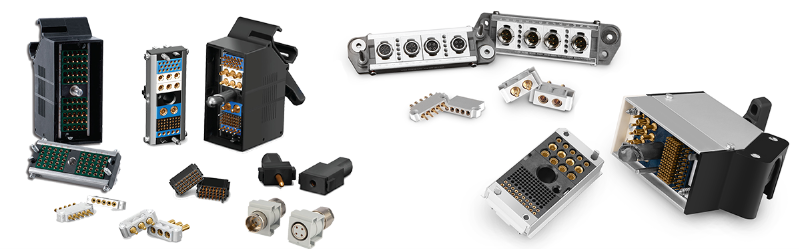
Engineers designing electronic systems for aerospace, defense, transportation, industrial automation, and test environments face a growing problem: need for more power, signal, and data requirements all of which must fit into less space with flexible mounting arrangements, without compromising reliability. Traditional connector approaches often mean multiple interfaces, greater complexity, and more maintenance. Modular connectivity offers a smarter alternative.
Why modularity matters for connectors
Traditional connector systems often require separate interfaces for different functions, increasing complexity and maintenance effort. Modular connectors change this paradigm by enabling one-connector-does-all approach, where multiple technologies can coexist within a single frame.
This modularity has several key advantages:
- Consolidate multiple connection and technology types into one connector;
- Reduce panel space, system complexity and cost;
- Increase flexibility for future upgrades without redesigning the whole connection architecture e.g. for high-speed data or higher power.
Smiths Interconnect, a Molex company, offers a modular connector portfolio that includes various modular and mini-modular series.
L series high density modular connector with over 40 years of pedigree!
The versality of the connector is reflected not only in its over 4 decades in production, but also in variety of applications the connector was designed in from end of line test and measurement to missile launchers. With requirements for electronics evolving, Smiths Interconnect, a Molex company, has optimized the L series, and added new modules with Cat5e and Cat6a and higher power up to 400A.
The L series is built on a simple yet powerful concept (modules and frames) which allows users to mix and match signal, power, RF, data transmission, fiber optic and pneumatic modules in an assortment of standard rack and panel or cable to panel frames.
The L Series high density modular connector features the premium hyperboloid contact technology known widely in the industry for its exceptional durability and electrical performance, especially while operating in demanding applications.
This technology ensures:
- Superior resistance to vibration and shock due to 360° contact of the pin surface by the socket wires;
- Up to 100,000 mating cycles, which are specially valued in end-of-line test and measurement;
- Increased meantime between failures (MTBF) which reduces downtime in mission-critical applications.
Enhanced data capabilities
The latest evolution of the series includes Cat5e and Cat6A Ethernet modules, compliant with IEEE 802.3 standards. These new modules combine:
- Proven hyperboloid contact reliability;
- High-quality polycarbonate insulation;
- Excellent signal integrity and performance.
This enables designers to seamlessly integrate high-speed data into modular connector configurations.
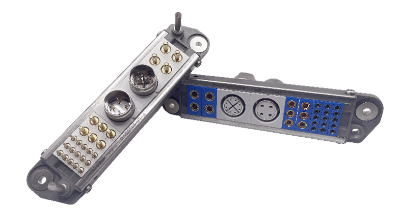
The enhanced L Series from Smiths Interconnect, a Molex company, supports multiple contact types within the same frame.
Key takeaways from the recent technical updates to enhance modular connector offering:
- Modular design: the connector series uses one-connector-does-all principle. Engineers can use two main elements of the connector - modules and frames, to create variety of different types of configurations for signal, power, coaxial, pneumatic, and high-speed data technologies.
- High reliability: Hyperboloid contacts provide durability for high-vibration environments and support up to 100,000 mating cycles, reducing downtime and increasing mean time between failures.
- Enhanced data capability: New Cat5e and Cat6A Ethernet modules comply with IEEE 802.3 standards and combine hyperboloid contact technology with high-quality polycarbonate insulators for industry compliance and performance.
- New online configurator: An intuitive drag-and-drop tool enables customers to design and customize connectors using standard components for faster turnaround and reduced lead times.
As systems grow more complex and performance expectations continue to increase, modular connectors are no longer just a nice-to-have option. They are a necessity for future-proofing designs. They enable engineers to create smarter, more reliable systems that are ready to meet the challenges of tomorrow.