

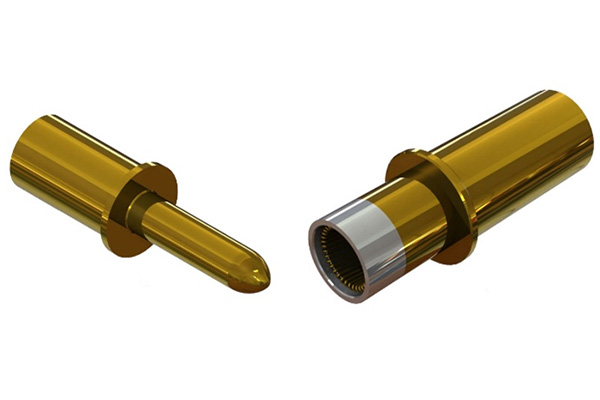
When working on high-voltage DC power transmission projects, most engineers focus on sizing batteries and cables correctly. However, the surprising reality is that connectors often represent the key link in the system.
Why? At the core of every connector lies its contact technology, which consists of pin and socket. While their surfaces appear smooth to the naked eye, they are full of microscopic irregularities. When transmitting DC power, current flows through these uneven touch points, creating what is known as constriction current. Combined with the inherent contact resistance of the materials, this leads to localized heating.
In simple terms:
Higher contact resistance = higher localized temperature rise = power loss due to Joule heating.
This means that even if you’ve perfectly sized your batteries and cables, choosing a wrong connector not designed for arduous applications can limit energy transfer and efficiency.
How can that power loss be addressed?
In our discussion with customers, we identified that in DC power transmission a staggering amount of power is lost due to connectors. To solve it, we developed Hypertac Green ConnectTM, a contact technology specifically designed for DC energy transmission and applications requiring peak current.
Peak current scenarios occur when a system for example rated for 300 amps needs momentarily 500 amps for 10–20 seconds. Traditional connectors struggle to operate for long at peak current. These connectors experience a steep temperature rise at peak current as they contacts they use have high contact resistance. Given the small headroom these contacts these connectors have, the system reaches its limiting operating temperature in a few seconds resulting to derate the current.
Hypertac Green ConnectTM tackles this challenge through three key technical aspects:
1. Material Science
We use highly conductive materials to minimize contact resistance.
2. Hyperboloid Contact Design
A unique wire structure around the pin ensures multiple contact points, reducing temperature rise.
3. Optimized Crimp Area
A specialized feature further lowers resistance, keeping the temperature curve shallow.
Why does this matter? In peak current environments, the Battery Management System (BMS) monitors temperature closely. If it hits a critical threshold, the system derates current. Hypertac Green ConnectTM provides the headroom needed to sustain elevated currents for up to 20–30 seconds, even under harsh conditions, while supporting thousands of mating cycles.
What applications benefit most from this technology?
Electrification is a mega-trend across industries, but not all connectors are application-specific designed. Many existing solutions were originally designed for static energy storage and later adapted for dynamic applications requiring peak current. Hypertac Green ConnectTM was purpose-built for these demanding environments.
Key application areas include:
• Aerospace & Defense
Emerging electric vertical take-off and landing (eVTOL) aircraft and land vehicles.
• Industrial & Mining
Electrification of mining equipment operating in rugged conditions.
• Railway Systems
High-voltage DC transmission with peak current requirements.
Across these sectors, Hypertac Green ConnectTM ensures reliable power delivery where performance and safety are critical.
Looking Ahead
As electrification accelerates, the demand for robust, efficient connectors will only grow. By addressing the key link in high-voltage systems, technologies like Hypertac Green ConnectTM pave the way for safer, more efficient energy transmission, powering the future of mobility in arduous applications.