 Skip to content


Factors in choosing the right RF Filter
RF filters are key signal conditioning components in radar and communication systems. They reduce receiver interference from unwanted signals, remove harmonics from transmitted signals, and, in the form of diplexers, protect receivers from a transceiver’s own high power transmit signal.
There are many factors to consider when choosing the appropriate RF filter for an application. The frequency range, fractional bandwidth, transition from the passband to the stopband, and the power level of the signal are some of the variables to consider. Additionally, insertion loss within the passband, the amount of rejection, and the size and cost are other variables. Often, filter selection will involve balancing performance versus small size and low weight.
Why choose Ceramic RF Filters
Ceramic filters were first introduced about 80 years ago and have remained a strong candidate for filter solutions due to their excellent performance, small size, and low cost. The filters are comprised of high Q, high dielectric constant ceramic resonators which are capacitively coupled and are typically surface mounted on a printed wiring board. The ceramic resonators are silver-plated and boast low temperature drift.
The high dielectric constant allows for smaller sized filter options, while the high Q available supports the low loss and high rejection these filters offer. Ceramic resonator filters are a very good topology for excellent performance and small size and weight. These filters are available to support frequency ranges from 400 MHz to 6 GHz.
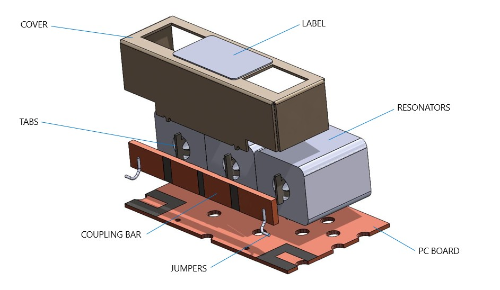
Diagram 1 - Ceramic Resonator Filter Design
Ceramic filters are used in commercial, defense and space markets. Applications are primarily within Wireless communications, Unmanned Aerial Vehicles (UAVs), Radar Systems, IoT and Satellite Communications. Design and manufacturing techniques are employed to optimize these filters for the different markets. For example, Diagram 1 shows an open frame design, however enclosed, hermetically sealed, versions can also be provided for humid environments.
In addition, these filters can withstand high vibration and shock conditions. They have successfully qualified for many of the environmental and physical characteristic tests per MIL-STD-202.
Ceramic filters are an excellent choice for RF designers when SWaP-C considerations, particularly size, weight, and cost are important. While offering lower cost and better performance than most discrete (lump element) solutions in the same frequency range, they maintain the same or even smaller footprint. Although they cannot compete with the performance of a high Q cavity filter solution, they are a fraction of the size. And while printed filters command attention today by their incredibly small envelope, ceramic filters will still offer better performance at a similar price in quantities.
Most solutions are surface mount, but Smiths Interconnect can also offer custom connectorized solutions with or without hermetic packaging.
Trade-offs when selecting a ceramic topology over other RF filters
One of the observations one might make after viewing the assembly in Diagram 1 is how few parts there are in a basic ceramic assembly. This is one of the characteristics that allow ceramics to generally be more cost effective than discrete or cavity solutions. Discrete assembly demands more skilled artisan labor while cavity solutions demand more CAD and CAM resources for machining as well as the higher-cost raw material.
The ceramic topology will generally outperform discrete solutions in same frequency range due to the higher "Q" as we saw during our discussion of advantages.
While cavity solutions generally outperform ceramic solutions, we have seen that at the same frequency, the cavity solution will be much larger, so here the ceramic has the advantage of physically smaller size.
Planar filters certainly command the advantage of the smallest footprint for a given frequency, but their performance will generally be less than ceramic solutions at a given frequency due to their limited quality factor or "Q".
Ultimately, the best type of RF filter for harsh environments will depend on the specific requirements of the application, including the environmental conditions it will be exposed to and the level of performance and reliability needed.
 |
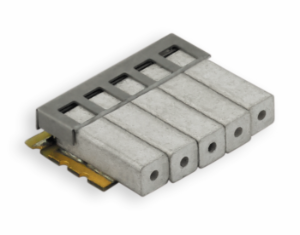 |
Diagram 2 - Smiths Interconnect's Ceramic Resonator Filters
Smiths Interconnect’s Ceramic RF Filters:
Smiths Interconnect is committed to providing technically advanced, high quality “state-of-the-art” RF Ceramic Filters, from 400 to 6000 MHz. With exceptional performance, surface mount technology, wide operating temperature range, and compact design, these filters are poised to enhance signal integrity and reliability across various harsh environments.
In addition the on-line Filter Select Plus tool can be used to generate datasheets and part numbers of a filter solution with a few simple inputs. By providing a few basic mechanical and electrical requirements the tool can filter through the available options and provide a basic datasheet with RF performance plots.
Whatever your application, Smiths Interconnect’s filter experts stand ready to work with you to arrive at the optimum filter solution based on your specification requirements.
As technology continues to advance, Smiths Interconnect remains a reliable partner in delivering cutting-edge solutions that drive the progress of the aerospace, defense, and telecommunications sectors.