

Batteries are at the heart of modern electrical architecture, enabling large-scale electrification. They don’t just store energy; they also facilitate cleaner operations and reduce environmental impact, providing a practical pathway to a low-carbon future. This is why battery systems are not optional add‑ons; they are core to the infrastructure for the energy transition.
Across applications in aerospace and defence, rail and mining, battery system architectures look different, but one component is always common: the power connector. Different applications, operating in different environments, different duty cycles, but a shared dependency on the same fundamental interface. And, as system power and current levels increase, this commonality exposes a fundamental technical vulnerability power loss.
The Challenge
As battery systems increase in power and current, the connector becomes a critical stress point. Figure 1 illustrates the key mechanisms involved with the electrical contacts in the power connector.
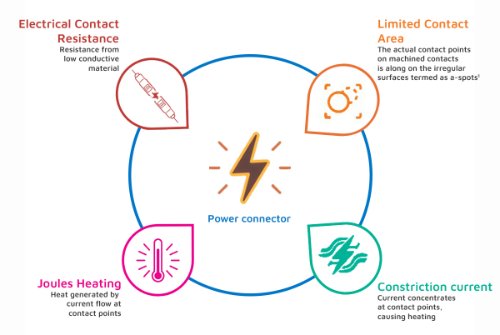
Figure 1 – Mechanisms in play within the electrical contact
It starts with the electrical contact resistance of the contacts. Even when using highly conductive materials, resistance exists at the interface between mating surfaces.
Contacts don’t touch uniformly, resulting in current flow through microscopic contact spots. This leads directly to Joule heating: heat is generated precisely at those contact points where current density is highest due to constriction.
If the physics was not enough, unforgiving at the electrical contacts’ interface in a power connector, the challenges are exacerbated by contaminant films, thermal cycling, vibration, and material degradation, which are commonly present where the connectors are operating.
As shown in Figure 2, these interplays reduce the amount of energy transferred.
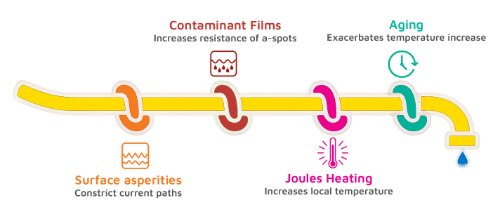
Figure 2 – Issues that exacerbate and limit power connector’s performance
Over time, these effects reduce the amount of energy transferred and accelerate performance degradation.
So, when we ask whether the connector is the weakest link, the physics tells us clearly: in high‑power electrified systems, connectors are not passive components - they are thermally and electrically active elements that directly limit reliability, efficiency, and scalability.
That is why connector design - contact geometry, material selection, surface treatment, and force management - is becoming just as critical as the design of the battery cells themselves.
The Solution
Multi‑point 360° contacts distribute current across many parallel contact paths, increasing the effective contact area and reducing constriction resistance. This approach directly improves current distribution, limits heat generation, and enhances long‑term performance.
Addressing contact resistance, managing heat, and maximizing effective contact area is essential if we want battery systems that are not just powerful, but safe, durable, and scalable across demanding application.
Our Core Technology
Hypertac Green Connect™ is a lead‑free and beryllium‑free, hyperboloid, multipoint 360° contact system designed to deliver low electrical resistance, superior current‑carrying capability, and exceptional mechanical robustness.
By combining a high‑conductivity copper alloy body with a genuine hyperboloid socket cage formed from high‑conductivity wires, this technology addresses the classic trade‑off between conductivity and mechanical integrity, delivering stable performance over life even in harsh environments.
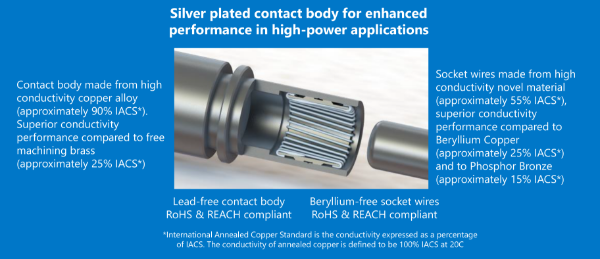
HPB (High-Power Battery) connector series
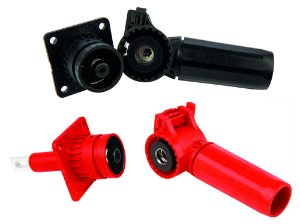 The HPB Connector series with Hypertac Green Connect™ technology is designed to handle greater currents with minimal losses while maintaining safety and durability under extreme operating conditions.
Beyond continuous operation, the HPB connector series supports robust peak current capability, making it suitable for applications characterised by transient high‑current events such as traction acceleration or inverter load steps.
In addition, the inclusion of a High Voltage Interlock (HVIL) enhances safety during connection and disconnection, while the compact design enables system miniaturisation, reduced harness weight, and optimised packaging.
The HPB connector series stands out as a next‑generation high‑power interconnect solution engineered for high performance, safety, and sustainability. Its combination of hyperboloid 360° contact geometry, high continuous and peak current capability, and HVIL safety integration allows it to address the key challenges associated with modern high‑power electrical systems operating in demanding environments.
For designers seeking to optimize both technical performance and lifecycle value, the HPB connector series provides an advanced and reliable solution.
Download the full technical article