Skip to content

KNB/KNC Series ESA Qualified

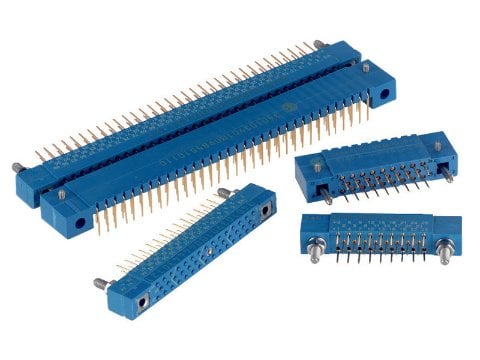
Based on the KN series MIL-DTL-55302 compliant connectors an ESA version of the KNB/KNC connectors has been created, which also offers signal contacts designed for demanding defense, commercial aerospace and space applications. They also are available in the 2 and 3 row series and offer flexibility not available with other interconnects.

Brochure 2D/3D Configure

Features & Benefits

  • Featuring Hypertac® Hyperboloid contact technology.
  • Mating and unmating cycle life up to 5.000 cycles.
  • Available in 2 & 3 row series from 17 and 160 contacts.
  • 0.100” (2.54 mm) on center (adjacent rows offset by 0.050” (1.27 mm) to allow straight printed circuit traces).
  • Straight dip, right angle solder, crimp, solder cup and Wire Wrap® terminations.
  • 0.024” (0.60 mm) diameter pins/sockets rated at 5 Amps.
  • Reinforced gold plating: 1,27 µm on active parts.
  • Average insertion/extraction force of < 30 g per contact.
  • Contacts removable from wiring side (front release, rear removable).
  • Alignment and keying provided by the end guides - 36 combinations (user changeable).
  • Contact resistance less than or equal to 8 mΩ.
  • Male or female contacts and guides available in either plug or receptacle.
  • Immunity to shock and vibration fretting.
  • Reinforced final production tests.

Overview

KN series ESCC3401/016 & ESCC3401/17 compliant connectors come in 2 - 3 row configurations designed with the legendary Hypertac® Hyperboloïd Technology. They were designed as high reliability printed circuit board connectors Specific ESA qualified offering pin counts from 17 to 160 contacts which are widely used in space applications.
 

Related Products

  • Image of KNB/KNC/KND Series

    KNB/KNC/KND Series

    Designed as high reliability printed circuit board connectors offering pin counts from 17 to 490 contacts which are widely used in defense, commercial aerospace and space applications.

Related News

  • Image of Optical interconnect for high-speed, high- bandwidth 10GigE and 40GigE cameras used in machine vision.

    Taking the Fast Bridge between Neural Networks

    Neural networks have been around since the 1950s. The advent of fast, massively parallel processors like the Graphics Processing Unit (GPU) have made neural network applications like object recognition feasible. Neural networks are one means used to create Artificial Intelligence (AI). The latest iPhones now have an AI chip, primarily to offload face recognition tasks.1 Voice translation tasks would also benefit from an AI chip. Google provides voice translation as long as there is access to a cloud. The ability to translate directly from a phone without requiring Internet access to Google engines would be advantageous, and it’s possible that the iPhone is headed in that direction.

  • Image of One World Web Coverage

    The Internet of Space and radiation resistant transceivers

    The explosion of worldwide communications over the past 25 years has led to the pervasive use of mobile and land communications equipment with an abundance of platforms, applications, and devices all driving the growth of many of the largest businesses in the world. There is no doubt that this trend will continue through the Internet of Things (IoT), and the arrival of the 5G technology along with improvements to the underlying network infrastructure. However, the next, ‘Small Step’ for man in terms of ubiquitous communications will be the ‘Giant Leap’ into the Internet of Space.